TRADING CARDS · ORANGE PARK, FL
TCG Supply Co: a custom Shopify store and buying program
A trading card retailer in Orange Park, Florida. A full custom card-grading and buying program with its own staff console: photograph a card, get a grade back, price it against live market data and make an offer on the spot.
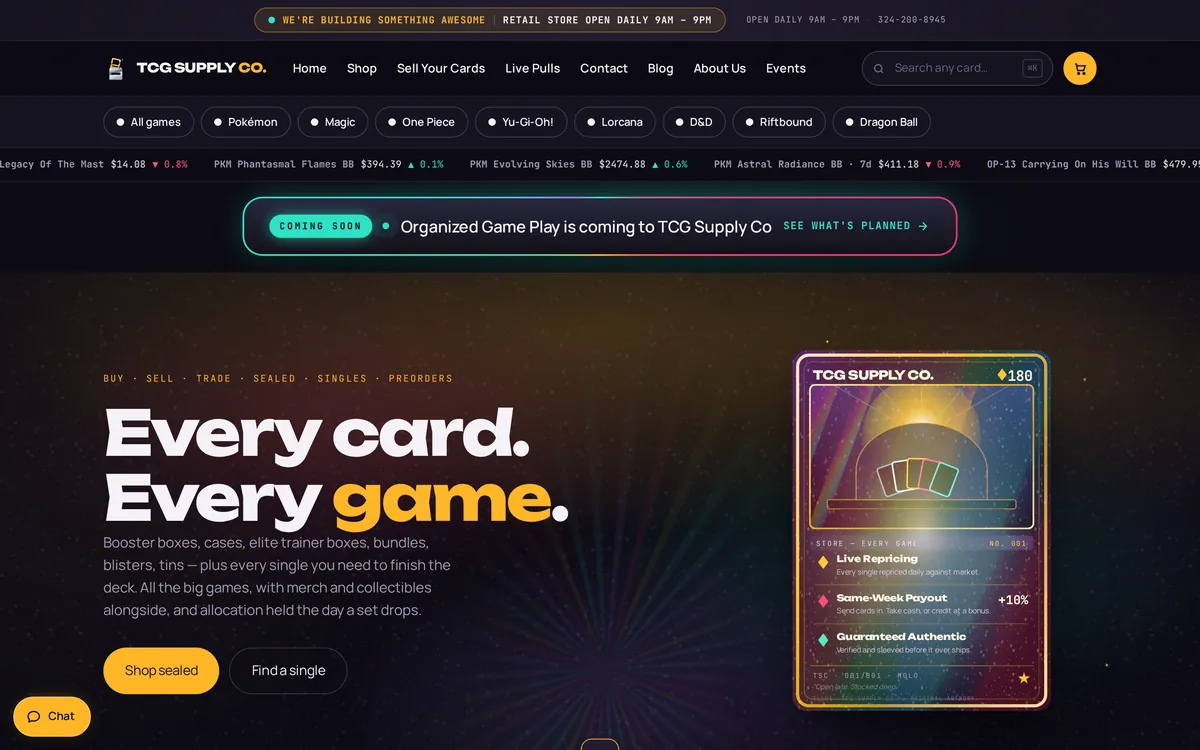
Buying a card is a pricing decision with a customer waiting.
Selling cards is a storefront problem. Buying them over a counter is a much harder one, and it is the half nobody sells software for.
Somebody walks in with a card and wants a number. Getting to that number means answering two questions at once. What condition is this card in, which can swing the value by multiples and is a judgment call that takes experience to make consistently. And what is that card worth this week, which is not what it was worth last week, because this is a market that moves on print runs, tournament results and whatever the internet decided matters on Tuesday.
Both answers have to arrive while a person stands at the counter. A shop that goes away to research, or that guesses low to stay safe, loses the card to the shop down the road that did not.
Why an app was never going to cover it
There is plenty of software for selling singles online and a reasonable amount for running inventory. There is very little for buying over a counter, and nothing we could find that ties grading, live market data and an offer into one screen a staff member can operate with a customer watching. The pieces exist separately, which means three tools, three logins and a staff member retyping numbers between them — which is the same as not having the tools at all when there is a queue.
And then there is the rest of the catalog
A card shop holds thousands of individual singles, each one its own price that moves independently of every other. Hand-pricing that is not work anybody can keep up with, so in practice it does not get done, and a store ends up selling cards below market and sitting on cards above it at the same time. Whatever solved the counter problem had to solve this one too, off the same data, or the shop would simply have two pricing systems that disagreed with each other.
A storefront, and a program written for the counter behind it.
One system, two audiences: the customer online and the staff member at the buy counter.
The public store, built for a card retailer rather than adapted from a general apparel design.
Staff photograph a card and get a grade back. Written for this shop; it is not a subscription with the shop’s logo on it.
The buy counter’s own screen, where the grade, the market price and the offer are all in one place instead of three tabs.
Card values pulled from live market data, so the number quoted is the number the market is at now.
Every single in the catalog reprices daily off the same data the counter uses, so the store and the buy desk never disagree.
Every part of the grading and buying program was written for this business. There was no app that did this.
How a buy happens at the counter.
Five steps, one screen, and the customer is still standing there when it finishes.
STEP 01
Photograph the card
Staff shoot the card on the console rather than describing it. The image is the input, so the process does not depend on how good a particular staff member is at wording a condition.
STEP 02
Get a grade back
The program returns a grade. That turns the most experience-dependent part of the transaction into something a new hire and a fifteen-year veteran do the same way.
STEP 03
Price it against live data
The grade is applied against live market data for that exact card, so condition and current value are combined rather than estimated separately and multiplied in somebody’s head.
STEP 04
Make the offer on the spot
The number comes out of the console while the customer is at the counter. No callback, no holding the card overnight, no guessing low to cover the uncertainty.
STEP 05
The same data reprices the store
Singles in the catalog reprice daily from the same source. The shop buys and sells against one view of the market instead of two.
Custom builds start at $2,500.
The storefront is the project. A program like the grading console is quoted on top of it.
Software written for one business is scoped separately from the store it sits behind, and it gets quoted before anything is built. Nothing gets discovered on the final invoice.
The services behind this build.
Every piece of it is something we do on its own as well.
— Start
Is there a job your staff do by hand every day?
That is usually the one worth writing software for. Tell us what it is and we will tell you whether it is worth building.