ECOMMERCE · CHILDREN’S CLOTHING
SweetiePeach: a brand and WooCommerce store for kids’ clothing
New and gently-used children’s clothing. We did the whole thing, from the name on the label to the checkout: brand and logo, a WooCommerce store, the product listings, and the email signup behind it.
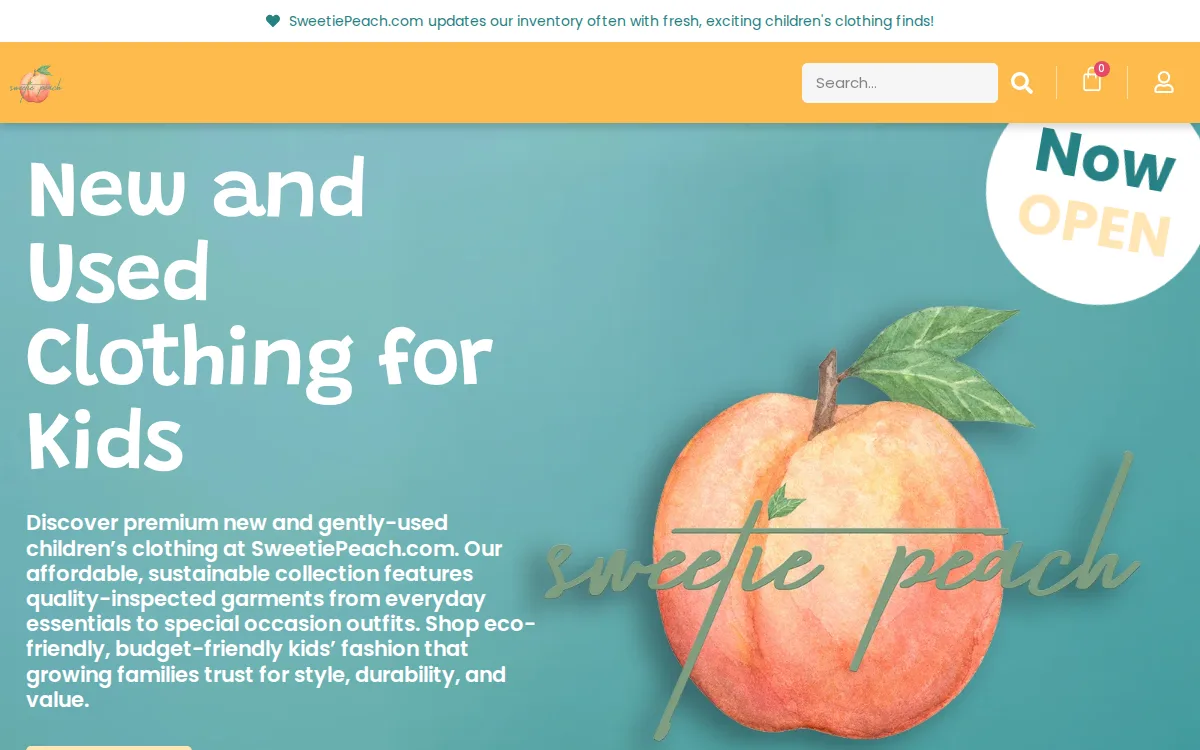
The founder knew the clothes. There was no store yet.
This one started earlier than most projects do — before the name, before the logo, before there was anything to put a checkout on.
SweetiePeach was built for a founder who knows children’s clothing inside out: which brands last, which sizes actually run true, what is worth buying second-hand and what is not. That knowledge is the entire business. Everything we built exists to get it in front of a parent who is standing in a different city, unable to feel the fabric.
What did not exist was any of the rest of it. No name, no mark, no store, no listings, no way to keep in touch with anybody who bought once. So the work started at the label and ran through to the checkout.
Two kinds of stock in one catalogue
The awkward part of this category is that the shop sells two things that behave nothing alike. New clothing is a product with variants: one item, several sizes, restockable. Gently-used clothing is a pile of one-offs. One size, one condition, one set of photographs, and when it sells it is gone for good and never comes back.
A catalogue has to hold both without making the customer do the work of telling them apart, and without making the founder maintain two completely different processes to get anything listed. That decision shapes the listings more than anything else on the project, because a resale item that takes fifteen minutes to list is a resale item that never gets listed.
Why the email signup is not an afterthought
Children’s clothing has a clock built into it. A customer’s need changes every few months, on its own, whether or not anybody markets to them — the child grows out of the size and they are back in the market. That makes the list of past customers unusually valuable, because a parent who bought a 2T last spring is a genuinely warm prospect for a 3T today, and they are the only people who already know the clothes are good. So the signup went in with the store, not into a later phase.
From the name on the label to the checkout.
Everything on this project was built from nothing, including what the business is called.
The label itself. The project started before there was one.
The mark and the look, built for a category where parents are deciding partly on whether the shop feels careful.
The full storefront, cart and checkout, built to carry new and gently-used stock in the same catalogue.
The catalogue written and loaded — the part that turns the founder’s knowledge of the clothes into something a parent can judge from a screen.
The list, built into the store from the start, because in this category last season’s customer is this season’s best prospect.
New and gently used, in one catalogue.
The whole listing approach comes out of one constraint: half the stock is unique and will never be restocked.
STEP 01
Treat new stock as a product
New clothing has sizes and can be reordered, so it is listed once and carries its variants underneath it, the way any clothing catalogue works.
STEP 02
Treat used stock as one of a kind
A gently-used item is a single unit. It gets its own listing, its own photographs and its own description, because there is nothing else exactly like it in the shop.
STEP 03
Keep listing fast enough to actually happen
A resale catalogue only works if adding an item is quick. If listing one piece is a chore, the stock sits in a bin and the store looks empty.
STEP 04
Say the condition plainly
A parent buying second-hand is buying reassurance as much as clothing. Condition described honestly is what makes the rest of the catalogue believable.
STEP 05
Capture the customer once
The signup runs in the store so a first-time buyer becomes somebody the shop can reach again in three months, when the size has changed and the need is back.
Custom builds start at $2,500.
Naming and brand work is priced separately from the store it ends up on.
A project that starts at the name is two engagements: the brand, and the store. They are quoted as two numbers rather than one, so it is clear what each is buying.
The services behind this build.
Every piece of it is something we do on its own as well.
— Start
Starting from nothing, including the name?
That is a normal place to start with us. Tell us what you want to sell and who you want to sell it to.