PERFORMANCE AUTO · FRANKFORT, IN
Grayless Automotive: brand, website and local SEO
A performance auto shop in Frankfort, Indiana that had no online presence at all before this. The whole brand was built here — identity, logo and guidelines — then the first website, the local search work and the social content running on it.
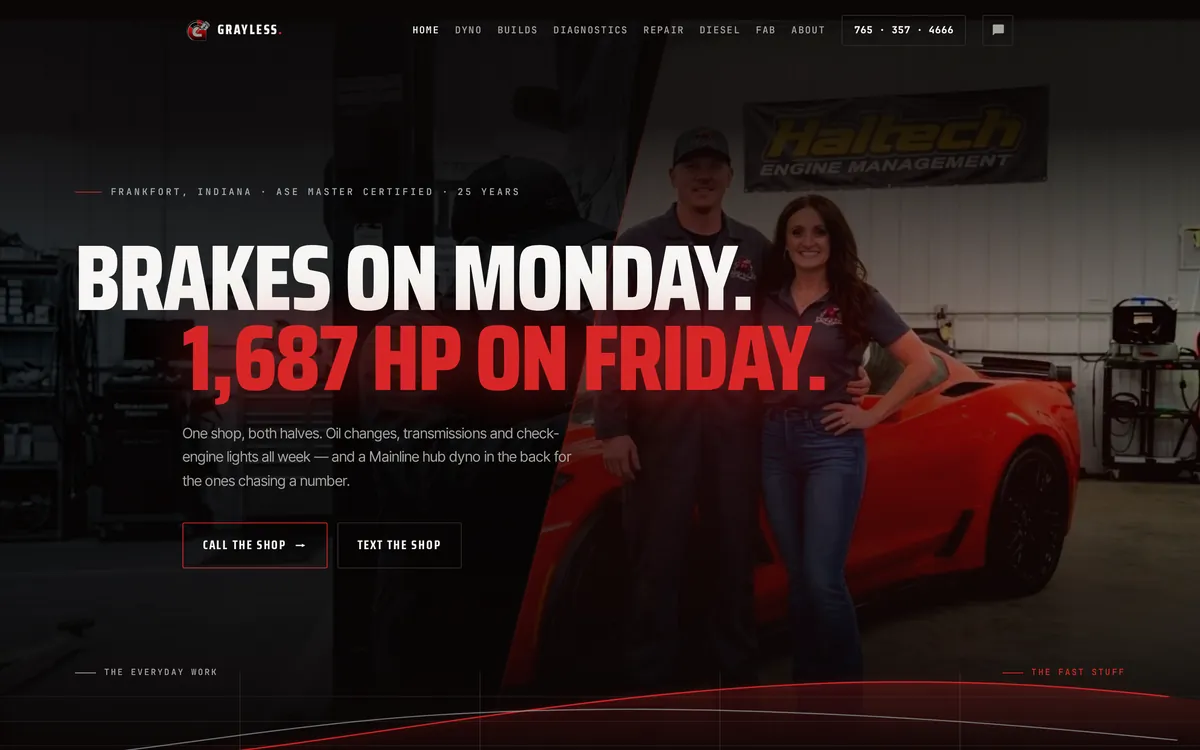
A performance shop is chosen before anybody visits it.
Nobody hands over a car they care about on a whim. The decision is made at a distance, from whatever the shop has put in front of them.
Performance work is not an errand. A customer picking a shop is deciding who gets to touch an engine they have spent years and real money on, and they make that decision before they ever walk through the door. What they have to go on is a search result, a set of photos and whatever the shop is willing to say in public about what it charges. That is the whole shop window.
Two things were in the way
The first was that the shop had no settled identity. Not simply a missing logo — a missing set of rules about what the brand looks like, so every flyer, sign and post was a slightly different business. That is invisible to the owner and obvious to a customer comparing three shops, because consistency is the cheapest signal there is that a business is run properly.
The second was that there was nothing to find. No website at all — a working shop with cars in the bay and no address on the internet, so a customer searching on a phone at a car meet got somebody else, every time. That is not a cosmetic gap to be closed later. It is the entire shop window missing. The site that closed it was written from an empty file rather than assembled out of a bought design, which is why it opens as fast as it does: a customer deciding between three shops on a phone does not wait, and a search engine does not have to guess how long a page takes — it measures.
The question nobody wants to ask out loud
The other decision on this project was to publish the dyno rates. Most shops in this trade make you call for a price, which quietly costs them the customers who will not call to ask a number they are worried about. Putting the rates on the page answers it before the phone rings, and it filters in the other direction too: the people who do call have already seen the figure and are calling about the work rather than about the cost.
The photography followed the same logic. Every performance shop’s website looks the same because they all pull from the same stock catalog, and a customer who has seen that engine bay on four other sites has learned nothing about this shop. The photos on this site are of this shop.
What it turned into
Grayless was a small business with no online presence when this started. It is now a full-time job for the Grayless family. A website did not do that on its own and we are not going to claim it did — the work going out of that bay did it. What the brand and the site did was make the shop findable, and make it look in public like the shop it already was, so the customers who were going to choose it could actually find it to choose.
The brand, then everything the brand runs on.
Built in that order deliberately, because a site, a listing and a social account are all just places the brand shows up.
The mark, and the rules that keep it the same wherever it appears — sign, page, flyer or post.
Written for this shop from an empty file rather than assembled out of a bought design, and fast because of how it was built rather than because a speed plugin was added afterwards.
One page per service, named the way a customer searches for it rather than the way the trade refers to it internally.
The prices, on the page. A deliberate decision, not an oversight.
Shot on site. The cars, the bays and the work, instead of the same stock engine bay every competitor is using.
The ongoing job of being the shop that comes up when somebody nearby searches for what this shop does.
Produced and published on the brand that was just built, so the accounts and the site are recognisably the same business.
How a shop gets found by the right customer.
Local search rewards being specific. A general page about a general shop competes with every general shop.
STEP 01
Name services the way customers say them
People do not search for what the trade calls a job. Every service page is named for the search, which is a copy decision made before a line of it is written.
STEP 02
Give each service its own page
One page per service beats one page listing all of them, because a search engine can only rank a page for what that page is about.
STEP 03
Put the price on it
A published rate answers the buying question on the page. It also makes the page substantially more useful than the competitor page that says call for pricing.
STEP 04
Photograph the actual shop
Original photography of real work is the one asset a competitor cannot copy from the same stock library everybody else is using.
STEP 05
Keep the local signals pointed at the shop
Customers for this trade are within driving distance, so the search work is local: the services named on the site have to match the searches happening near the door.
Custom builds start at $1,800.
Brand work and ongoing search and social are priced separately from the build.
A full brand build, a website and monthly search and social work are three different engagements. They are quoted as three numbers so it is clear what each one is buying.
The services behind this build.
Every piece of it is something we do on its own as well.
— Start
Does your shop come up when somebody nearby searches for it?
If you are not sure, that is an answer. Tell us what you do and where you do it.